


Page 40 - IMPC Education Book_low res
P. 40
MINERALS INDUSTRY EDUCATION AND TRAINING II
young professionals. More than 65% interactions with young professionals
at least weekly, and 45% interact with them daily, meaning that they are in
touch with their educational level and performance.
Results
The survey consisted of six questions about the 92 respondents and their
backgrounds, and a further nine questions about their views on mineral
processing education and training.
The nine education and training questions concentrated on three themes:
1. specific knowledge, skills and competency requirements for mineral
processing professionals
2. how well universities are meeting industry needs
3. how organisations fill graduate competency gaps using ongoing
training and professional development
Knowledge, Skills and Competencies - What Graduates
ought to know
Specific mineral processing competencies
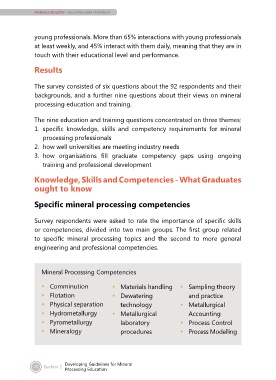
Survey respondents were asked to rate the importance of specific skills
or competencies, divided into two main groups. The first group related
to specific mineral processing topics and the second to more general
engineering and professional competencies.
Mineral Processing Competencies
Comminution Materials handling Sampling theory
Flotation Dewatering and practice
Physical separation technology Metallurgical
Hydrometallurgy Metallurgical Accounting
Pyrometallurgy laboratory Process Control
Mineralogy procedures Process Modelling
Developing Guidelines for Mineral
28 Section 2
Processing Education

