


Page 116 - IMPC Education Book_low res
P. 116
MINERALS INDUSTRY   EDUCATION AND TRAINING II


            The data were obtained from the information available at the Ministry of
            Education (Servicio de Información de Educación Superior del Ministerio
            de Educación (SIES), 2006-2015), whose digital information is available
            only for the last eight years. Figure 1 shows that the academic offerings
            have increased the total number of registered students, exceeding more
            than five-fold the number of first year students that there were in 2007. A
            difference is also seen between the offerings and first year registrations,
            showing clearly that registration is not always completed or else there is
            overflow. Another important data in this figure is that the total graduates
            come from admissions to first year at least four years earlier for mining
            technicians, five years earlier for mining engineering, and six years
            earlier for mine civil engineering. Therefore, to relate the retentions we
            must consider this time lag, to which must be added the actual average
            graduating time, which is 18 semesters (9 years) for mine civil engineering,
            13 semesters (6.5 years) for mining technicians and mining engineers –
            see Table 3, with information provided by some universities (Servicio de
            Información de Educación Superior del Ministerio de Educación (SIES),
            2006-2015).


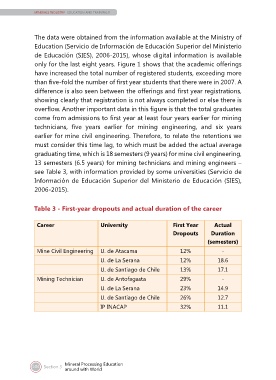
            Table 3 - First-year dropouts and actual duration of the career

             Career              University            First Year   Actual
                                                       Dropouts    Duration
                                                                  (semesters)
             Mine Civil Engineering  U. de Atacama       12%          -
                                 U. de La Serana         12%         18.6
                                 U. de Santiago de Chile  13%        17.1
             Mining Technician  U. de Antofagasta        29%          -
                                U. de La Serana          23%         14.9
                                U. de Santiago de Chile  26%         12.7
                                IP INACAP                32%         11.1


                     Mineral Processing Education
           104   Section 3
                     around with World

