


Page 196 - IMPC Education Book_low res
P. 196
MINERALS INDUSTRY   EDUCATION AND TRAINING II


            professional networking sites such as LinkedIn (https://au.linkedin.com/) it
            is possible to get some sense of the background and educational setting
            of those who list mineralogy as one of their skills. Close to 28 000 of those
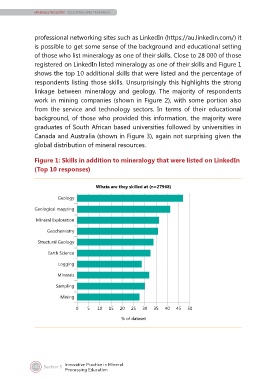
            registered on LinkedIn listed mineralogy as one of their skills and Figure 1
            shows the top 10 additional skills that were listed and the percentage of
            respondents listing those skills. Unsurprisingly this highlights the strong
            linkage between mineralogy and  geology. The majority of respondents
            work in mining companies (shown in Figure 2), with some portion also
            from the service and  technology sectors. In terms of their  educational
            background, of those who provided this information, the majority were
            graduates of South African based universities followed by universities in
            Canada and Australia (shown in Figure 3), again not surprising given the
            global distribution of mineral resources.

            Figure 1: Skills in addition to mineralogy that were listed on LinkedIn
            (Top 10 responses)


                               Whata are they skilled at (n=27968)
                   Geology
            Geological mapping
            Mineral Exploration

                Geochemistry
             Structural Geology
                Earth Science
                   Logging
                   Minerals
                   Sampling

                    Mining
                         0  5   10  15  20  25  30  35  40  45  50
                                       % of dataset


                     Innovative Practice in Mineral
           184   Section 5
                     Processing Education

