


Page 200 - IMPC Education Book_low res
P. 200
MINERALS INDUSTRY   EDUCATION AND TRAINING II


            promotes peer to peer learning and widens participation. Opportunities
            for active learning associated with experiential,  problem and project-
            based  learning  promote  collaboration  among  students  have  been
            provided by using realistic problems or situations and as a result a deeper
            understanding of the relationship between theory and practice  can be
            developed (Crosling et al, 2009). Implementing these types of authentic
            learning experiences are a mechanism for providing the industry with high
            quality graduates and enhancing student retention, both of which will
            contribute to sustaining the skills pipeline.


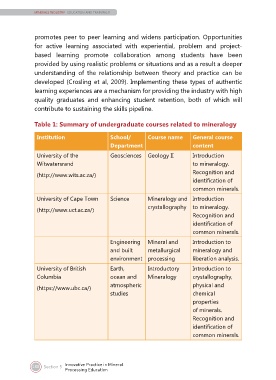
            Table 1: Summary of undergraduate courses related to mineralogy
             Institution            School/    Course name   General course
                                    Department               content
             University of the      Geosciences  Geology II  Introduction
             Witwatersrand                                   to mineralogy.

             (http://www.wits.ac.za/)                        Recognition and
                                                             identification of
                                                             common minerals.
             University of Cape Town  Science  Mineralogy and  Introduction
                                               crystallography  to mineralogy.
             (http://www.uct.ac.za/)
                                                             Recognition and
                                                             identification of
                                                             common minerals.
                                    Engineering  Mineral and   Introduction to
                                    and built   metallurgical   mineralogy and
                                    environment processing   liberation analysis.
             University of British   Earth,    Introductory   Introduction to
             Columbia               ocean and   Mineralogy   crystallography,
                                    atmospheric              physical and
             (https://www.ubc.ca/)
                                    studies                  chemical
                                                             properties
                                                             of minerals.
                                                             Recognition and
                                                             identification of
                                                             common minerals.


                     Innovative Practice in Mineral
           188   Section 5
                     Processing Education

