


Page 176 - IMPC Education Book_low res
P. 176
MINERALS INDUSTRY   EDUCATION AND TRAINING II


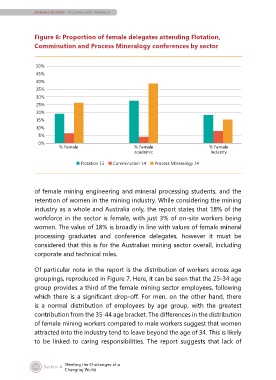
            Figure 6: Proportion of female delegates attending Flotation,
            Comminution and Process Mineralogy conferences by sector


            50%
            45%
            40%
            35%
            30%
            25%
            20%
            15%
            10%
             5%
             0%
                    % Female               % Female                % Female
                                           academic                industry
                          Flotation 15  Comminution 14  Process Mineralogy 14


            of female mining engineering and mineral processing students, and the
            retention of women in the mining industry. While considering the mining
            industry as a whole and Australia only, the report states that 18% of the
            workforce in the sector is female, with just 3% of on-site workers being
            women. The value of 18% is broadly in line with values of female mineral
            processing graduates and conference delegates, however it must be
            considered that this is for the Australian mining sector overall, including
            corporate and technical roles.

            Of particular note in the report is the distribution of workers across age
            groupings, reproduced in Figure 7. Here, it can be seen that the 25-34 age
            group provides a third of the female mining sector employees, following
            which there is a significant drop-off. For men, on the other hand, there
            is a normal distribution of employees by age group, with the greatest
            contribution from the 35-44 age bracket. The differences in the distribution
            of female mining workers compared to male workers suggest that women
            attracted into the industry tend to leave beyond the age of 34. This is likely
            to be linked to caring  responsibilities.  The report suggests that  lack of


                     Meeting the Challenges of a
           164   Section 4
                     Changing World

