


Page 171 - IMPC Education Book_low res
P. 171
A ROADMAP FOR MINERALS PROCESSING EDUCATION


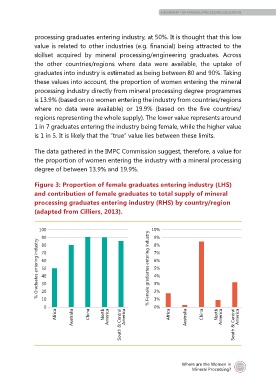
            processing graduates entering industry, at 50%. It is thought that this low
            value is related to other industries (e.g. financial) being attracted to the
            skillset acquired  by  mineral  processing/engineering  graduates.  Across
            the  other  countries/regions where  data  were  available,  the  uptake  of
            graduates into industry is estimated as being between 80 and 90%. Taking
            these values into account, the proportion of women entering the mineral
            processing industry directly from mineral processing degree programmes
            is 13.9% (based on no women entering the industry from countries/regions
            where no data were available) or 19.9% (based on the five countries/
            regions representing the whole supply). The lower value represents around
            1 in 7 graduates entering the industry being female, while the higher value
            is 1 in 5. It is likely that the “true” value lies between these limits.

            The data gathered in the IMPC Commission suggest, therefore, a value for
            the proportion of women entering the industry with a mineral processing
            degree of between 13.9% and 19.9%.

            Figure 3: Proportion of female graduates entering industry (LHS)
            and contribution of female graduates to total supply of mineral
            processing graduates entering industry (RHS) by country/region
            (adapted from Cilliers, 2013).

             100                                 9%
             % Graduates entering industry 90   % Female graduates entering industry 10%
                                                 8%
              80
              70
                                                 7%
                                                 6%
              60
              50
                                                 5%
                                                 4%
              40
                                                 3%
              30
              20
                                                 1%
              10
               0                                 2%
                                                 0%
                   Africa  Australia  China  North   America  South & Central   America  Africa  Australia  China  North   America  South & Central   America


                                                          Where are the Women in   159
                                                             Mineral Processing?

