


Page 174 - IMPC Education Book_low res
P. 174
MINERALS INDUSTRY   EDUCATION AND TRAINING II


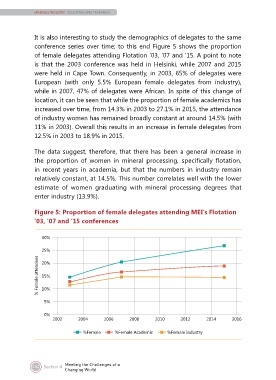
            It is also interesting to study the demographics of delegates to the same
            conference series over time; to this end Figure 5 shows the proportion
            of female delegates attending Flotation ’03, ’07 and ’15. A point to note
            is that  the 2003 conference was held in Helsinki,  while 2007 and 2015
            were held in Cape Town. Consequently, in 2003, 65% of delegates were
            European  (with  only 5.5% European  female delegates from industry),
            while in 2007, 47% of delegates were African. In spite of this change of
            location, it can be seen that while the proportion of female academics has
            increased over time, from 14.3% in 2003 to 27.1% in 2015, the attendance
            of industry women has remained broadly constant at around 14.5% (with
            11% in 2003). Overall this results in an increase in female delegates from
            12.5% in 2003 to 18.9% in 2015.

            The data suggest, therefore, that there has been a general increase in
            the  proportion  of  women  in  mineral  processing,  specifically  flotation,
            in recent years in academia, but that the numbers in industry remain
            relatively constant, at 14.5%. This number correlates well with the lower
            estimate of women graduating with mineral processing degrees that
            enter industry (13.9%).

            Figure 5: Proportion of female delegates attending MEI’s Flotation
            ’03, ’07 and ’15 conferences


              30%
              25%
             % Female attendees  15%
              20%


              10%
               5%

               0%
                 2002     2004    2006    2008    2010    2012    2014    2016
                           %Female   %Female Academic  %Female Industry


                     Meeting the Challenges of a
           162   Section 4
                     Changing World

