


Page 67 - IMPC Education Book_low res
P. 67
A ROADMAP FOR MINERALS PROCESSING EDUCATION


            Logic Model Activities


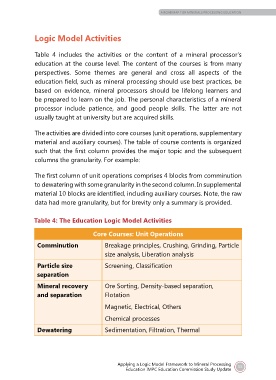
            Table 4 includes the activities or the content of a mineral processor’s
            education at the course level. The content of the courses is from many
            perspectives. Some  themes are general  and cross  all aspects of the
            education field, such as mineral processing should use best practices, be
            based on evidence, mineral processors should be lifelong learners and
            be prepared to learn on the job. The personal characteristics of a mineral
            processor include patience,  and  good  people  skills.  The latter  are not
            usually taught at university but are acquired skills.

            The activities are divided into core courses (unit operations, supplementary
            material and auxiliary courses). The table of course contents is organized
            such that the first column provides the major topic and the subsequent
            columns the granularity. For example:


            The first column of unit operations comprises 4 blocks from comminution
            to dewatering with some granularity in the second column. In supplemental
            material 10 blocks are identified, including auxiliary courses. Note, the raw
            data had more granularity, but for brevity only a summary is provided.

            Table 4: The Education Logic Model Activities

                              Core Courses: Unit Operations
             Comminution          Breakage principles, Crushing, Grinding, Particle
                                  size analysis, Liberation analysis
             Particle size        Screening, Classification
             separation
             Mineral recovery     Ore Sorting, Density-based separation,
             and separation       Flotation
                                  Magnetic, Electrical, Others

                                  Chemical processes
             Dewatering           Sedimentation, Filtration, Thermal


                                      Applying a Logic Model Framework to Mineral Processing   55
                                        Education IMPC Education Commission Study Update

